

June 4, 2026
/
You’re standing in a backyard that’s frozen solid, wondering if starting a pool project now is smart or slightly ridiculous. It’s a fair question, and the honest answer is more nuanced than the “act now and save big” pitch you’ll find on most pool sites.
Winter pool installation can save you real money and real time and not through a blanket seasonal discount. The savings come from less competition for contractor calendars, faster permit turnaround, and a fiberglass shell that’s built for the schedule winter actually gives you. There are also genuine limits worth knowing before you break ground.
This page covers the pros, cons, and true costs of installing a pool during the winter months. If your real question is when to start the planning, permitting, and budgeting work rather than the on-site construction itself, planning your pool installation is the more direct answer.
Quick Tips for Cheaper Pool Installation in Winter
- Winter pool installation can lower your total cost, mainly through lighter demand on contractor calendars and permit offices, not a flat seasonal discount on the pool itself.
- A one-piece fiberglass shell is manufactured off-site and delivered ready to set, which makes it far less weather-dependent than pour-in-place concrete or gunite.
- Deep-freeze ground and severe weather can still pause excavation, so winter installation is more feasible in some climates than others.
- Some on-site work, including electrical and gas hookups, legally requires licensed pros regardless of season.
- Starting in winter positions your pool to be tested, inspected, and swim-ready close to when the weather turns.
Is a winter pool installation actually cheaper?
Sometimes, it helps to know exactly where the savings come from.
A fiberglass pool shell’s manufacturer-direct price doesn’t change with the season. Shells start at $12,500, and a total owner-builder project typically runs $30,000–$50,000 once excavation, electrical, permits, and add-ons are factored in, saving $10,000–$20,000+ compared to a full-service build. That math holds whether you break ground in January or June.
What does shift with the season is everything around the shell. Excavation crews, electricians, and other trades often have lighter schedules in winter, which can mean more flexibility on timing and, in some markets, more room to negotiate. Permit offices process winter applications faster too, simply because fewer homeowners are applying. None of that is a guaranteed discount, and it varies by contractor and county, but it’s a real, honest advantage that spring loses the moment everyone else has the same idea.
If a firm number would help you plan, flexible financing options through partners like VistaFi and HFS Financial can turn your total project cost into a predictable monthly payment before you commit to a start date.
What actually changes between a winter start and a spring start
| Cost factor | Winter | Spring |
|---|---|---|
| Fiberglass shell price | Same manufacturer-direct price | Same manufacturer-direct price |
| Contractor and trade availability | Typically more open scheduling | Peak demand, calendars fill fast |
| Permit office turnaround | Lighter application volume | Heaviest volume of the year |
| Popular models and gel coat colors | Better availability | First to sell out or backorder |
| Ready-by-summer odds | Higher, with more buffer for weather | Depends on how early spring you start |
The shell price never moves. Everything else in that table is about competing for less-crowded calendars and availability.
Winter installation feasibility: ground conditions and weather
Frozen ground is the first worry most homeowners raise.
Excavation depends on how deep the freeze line runs in your area, not the calendar date. In genuine freeze climates, frozen soil can pause digging for weeks at a time, and no contractor, fiberglass or otherwise, can safely excavate through solid frost. In milder climates, or during a mild stretch within a colder one, ground conditions rarely stop a winter project at all. Checking your local frost-line depth, which the National Weather Service publishes by region, is a useful first step before you commit to a start date.
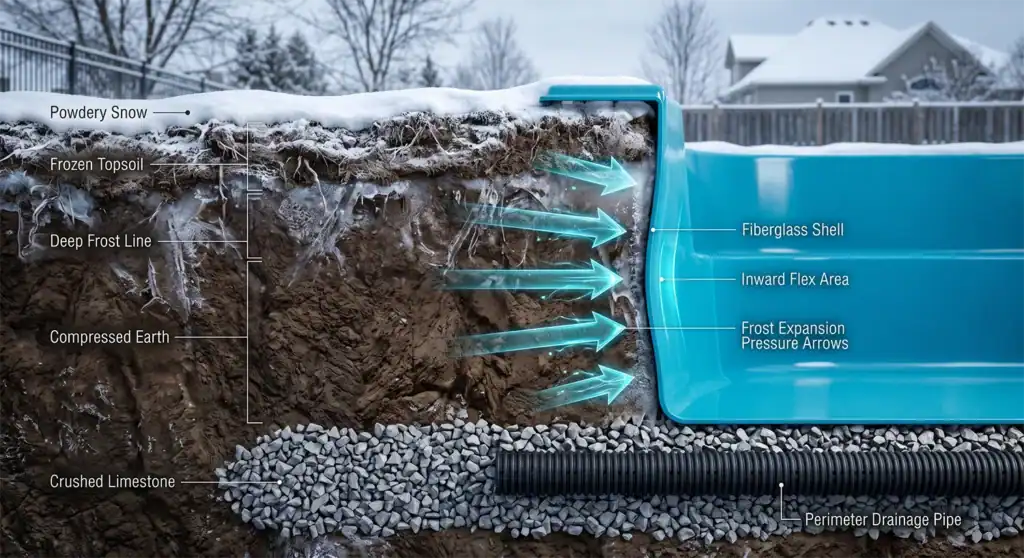
This is where a one-piece fiberglass shell changes the equation. It arrives from the factory already molded and finished, so weeks of on-site forming and curing that a concrete or gunite pool requires become days of installation once the ground is workable. Fiberglass also flexes with freeze-thaw ground movement instead of cracking, provided it’s set on a proper crushed-stone base with perimeter drainage engineered for your soil and frost line. For the full picture on how fiberglass performs through repeated winters, see our guide to fiberglass pools in cold climates.
What can slow down or complicate a winter installation
Winter installation has real trade-offs, and pretending otherwise wouldn’t be honest.
- Weather delays: a hard freeze, heavy snow, or an ice storm can pause excavation and backfill for days at a time, even in climates where winter work is generally feasible.
- Material curing time: concrete decking and certain sealants cure more slowly in cold temperatures, which can stretch the finishing stages of a project.
- Licensed-trade scheduling: electrical and gas work, which legally requires licensed professionals, can face its own winter scheduling limits independent of the pool shell itself.
- Permit and inspection timing: some municipalities slow down building-department staffing around the holidays, which can offset some of the off-season speed advantage.
None of these rule out a winter start. They’re simply the honest reasons a winter timeline needs a buffer that a summer timeline doesn’t.
What pool companies actually do in winter
It’s a fair question, since “winter” and “pool” don’t sound like they belong in the same sentence. In practice, most vetted installers use the slower months for excavation and site work they can schedule flexibly, coordinating around weather windows instead of racing a summer backlog. It’s also when they catch up on permit paperwork and prep for the models that will be in highest demand once spring hits. That lighter workload is exactly why winter scheduling tends to move faster than a spring one.
Steps to plan and execute a winter pool installation
A winter installation works best when it follows a deliberate sequence, not a rush to beat the frost.
- Check your site’s ground conditions. Ask your local building department or an excavation contractor about frost-line depth and drainage on your specific lot before you finalize a start date.
- Choose owner-builder or coordinated installation. Acting as your own general contractor saves the most but puts you in charge of scheduling excavation, electrical, and inspections. Coordinated installation through our vetted installer network trades some of that savings for less on your plate. Winter is a good time to lock in either path before spring calendars fill.
- Line up licensed trades early. Electrical and gas work often has its own winter scheduling limits, so book these separately from your excavation timeline.
- Confirm your permit timeline. A quick call to your building department tells you whether you’re looking at a two-week turnaround or a longer one this time of year.
- Winter-proof what’s already in the ground. If equipment or plumbing sits exposed while work is paused, ask your installer or contractor about temporary protection against freeze damage.
- Schedule your spring startup now. Booking water testing and equipment inspection ahead of peak season means you’re not waiting in line with everyone else once the weather turns.
Getting your pool ready for spring
The payoff of a winter start is a pool that’s genuinely ready when swim season arrives, not one still working through a punch list.
Once your shell is set and backfilled, water testing and equipment inspection can happen well before peak season, so small issues surface while there’s still time to fix them without cutting into your first weeks of swimming. If you installed in true winter conditions, reopening your pool after winter walks through the same startup checklist, chemistry balancing included.
Winter is also a practical time to finalize heater and cover decisions, since both affect your permit application and your total budget. A pool heater matched to your climate and fuel access can stretch your swim season by months rather than weeks, and deciding on one now means one clean permit submission instead of amendments later.
A mesh safety cover is worth locking in at the same time, both for the debris protection it offers while your yard finishes settling and for the layered pool safety it gives families with young kids or pets around a newly finished pool. Bundling these decisions into your original permit application, rather than adding them later, is one of the quieter ways a winter start saves you both time and paperwork.
Start the conversation before spring fills every calendar
Winter pool installation isn’t a guaranteed discount, and it isn’t right for every climate. It’s a real window where contractor calendars, permit offices, and a fast-to-install fiberglass shell line up in your favor, if your ground conditions allow it.
Pool Brokers USA has helped more than 1,500 families across 17 states weigh this exact trade-off, from checking frost lines to choosing between owner-builder and coordinated installation. Request a free, no-obligation quote and we’ll help you figure out whether this winter makes sense for your backyard.
Latest Posts
The Fiberglass Pool Installation Process, Step by Step
Budgeting for a Fiberglass Pool: Every Cost Beyond the Shell
Saltwater Pools: Why Fiberglass Handles Salt Better Than Concrete
Delivery Day Checklist: How to Inspect Your Fiberglass Pool Shell
How Much Time Does Pool Maintenance Really Take?
Shipping Container Pools or Fiberglass: Which Is Better?
Fiberglass vs. Natural Swimming Pools: A Practical Cost and Maintenance Comparison
Fiberglass vs. Gunite Pools: How Construction Method Shapes Lifespan and Care
Shell Price vs. Total Project Cost: Reading a Fiberglass Pool Quote
The Fiberglass Pool Buying Guide for First-Time Buyers
Visit Our Blog
Share This Post
(opens in a new tab)
(opens in a new tab)
(opens in a new tab)