

October 28, 2026
/
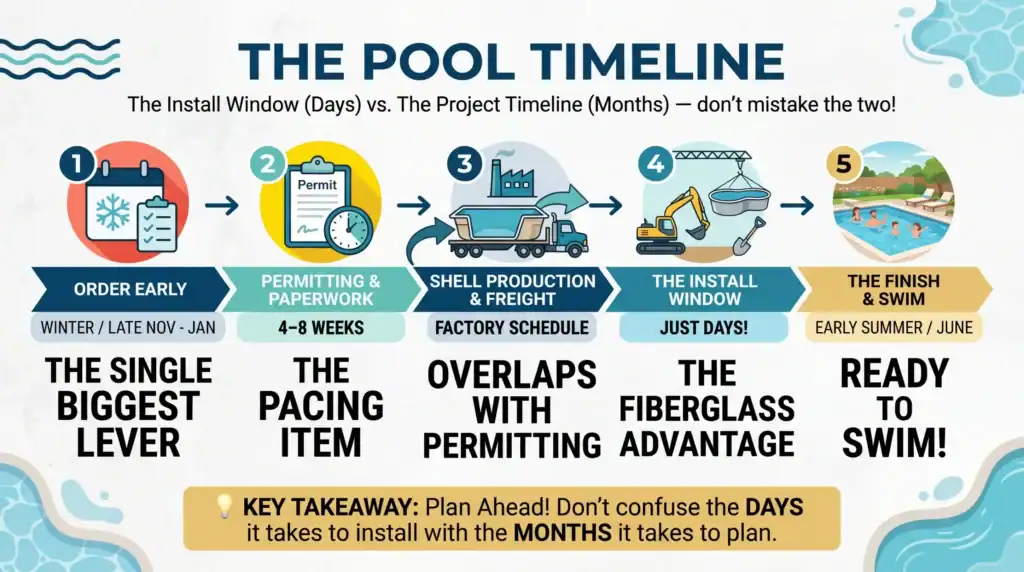
Installing a fiberglass pool on-site takes just days, but the full process from order to first swim usually takes one to six months. Permitting (often 4–8 weeks), factory production, and delivery set the timeline long before installation begins.
Here’s the misunderstanding that launches a thousand disappointed phone calls: a buyer hears “fiberglass installs in days!”, true, and mentally books a pool party for three weekends out.
This guide replaces that wishful math with the real schedule: every phase with honest ranges, why permitting is the sneaky pacing item, what the factory clock looks like, and the overlap strategy that gets families swimming a season earlier than procrastinators. If you’re asking how long to get a pool, here’s the whole honest answer right here.
Key Takeaways
- The install window (days) and the project timeline (months) are different clocks; conflating them is the number-one pool-buyer scheduling mistake.
- Permitting commonly runs 4–8 weeks and varies by county; it’s usually the pacing item, not the fiberglass.
- Shell production and oversized-load freight run on the factory’s schedule, and they can overlap with permitting if you order early.
- The famous fiberglass advantage is real: excavation, base, and shell set compress weeks of traditional construction into days.
- The single biggest lever is ordering early; a winter order can mean a June swim, while a May order often means next season.
Why timeline confusion happens
Pool marketing loves the crane shot: shell swinging over the house, in the ground by lunch. It’s real, and it’s also the last 5% of the calendar.
A pool project is a chain of dependent phases, and the chain is only as fast as its slowest links.
The fiberglass shell eliminates long on-site concrete work, making installation fast. However, permits, inspections, production, and shipping still take time for all pools.
So the honest framing for your pool project schedule: fast product, normal paperwork, real logistics. Plan the year around the whole chain, and the chain will genuinely surprise you on the short side; plan around the crane shot, and everything will feel late.
The fiberglass pool installation timeline, phase by phase
Here’s pool order to completion, with honest ranges for each phase:
- Research and model selection: days to weeks, entirely your pace.
- Quote, contract, and order: days once you’ve chosen; this starts every other clock.
- Permitting: commonly 4–8 weeks, county-dependent; runs in parallel with production when ordered early.
- Shell production and freight: weeks on the factory schedule, plus oversized-load routing to your state.
- Excavation, base, and shell set: days – dig, crushed-stone base, drainage, crane set, level.
- Trades, backfill, decking, and inspections, several weeks: licensed electrical (and plumbing where required), engineered backfill, coping, decking, final inspections; weather-sensitive.
- Fill, startup, and water balancing, days, then the first cannonball.
Add the phases and you get the honest total: a few months for a smooth project, longer where permits crawl or decking scope is ambitious. The full choreography, with what happens at each handoff, lives in the pool ordering process.
Permitting: the pacing item nobody budgets time for
If your project runs “late,” odds are it was never late; it was waiting in a county queue.
Pool permits are non-negotiable and genuinely useful, they enforce the barrier, electrical, and setback rules that protect your family and your resale, but their timelines vary wildly: one county turns permits in a week, its neighbor takes two months, and summer application surges stretch everyone. Barrier and fencing requirements ride along with the pool permit in most jurisdictions.
Three moves defang the permit clock. Apply for your permit immediately after ordering, this is the overlap play, letting government time and factory time run simultaneously.
Ensure you submit complete applications, bounce-backs for missing site plans are the most common self-inflicted delay.
One more permit reality worth knowing: inspections bookend the build, not just the start. The permit that took 4–8 weeks to issue also schedules the mid-project and final inspections, and inspector availability adds small waits near the end. Budget a few flex days in the finishing weeks and those waits never touch your swim date.
Owner-builders handle permit filing themselves with that guidance; on the coordinated path, installation coordination manages the sequence through the vetted network.
Production and freight: the factory clock
While the county reads your site plan, your shell should already be in production.
Production time depends on the factory queue (seasonal, busiest in spring), your model and color, and the build itself: molding, laminating, curing, trimming, and inspection don’t rush well, which is exactly what you want for a 25+ year product. Freight adds the oversized-load logistics: state permits for the route, scheduling, and delivery windows.
You control the calendar here with one decision: when you order. An order placed in November hits a quiet factory and arrives while your permit finishes; an order placed in May joins the spring rush at both the factory and the permit office. Same pool, different summer, which is the entire argument for winter pool ordering.
Install week: where fiberglass earns its reputation
Now the part the videos love, and honestly, it deserves the hype.
With permits in hand and the shell en route, the site work compresses beautifully: excavation cut to the model’s dimensions, crushed-stone base and perimeter drainage placed and compacted, and then delivery day, the crane lifts the shell from trailer to hole, and by that evening there is unmistakably a pool in your yard. Expect days, not the weeks-to-months of sprayed concrete construction.
The following stretch is steadier: licensed electricians wire and bond the pool (always licensed pros, that’s code, not caution), plumbing is connected and pressure-tested, engineered backfill goes in as the pool fills, and coping and decking build the finished edge. Inspections punctuate the sequence. Several weeks is typical, driven more by decking scope and weather than by the pool itself.
Then water balancing, equipment startup, and the swim you scheduled months ago, on time, because you planned the whole chain.
Two path notes for this stretch. Owner-builders schedule these trades directly, which saves real money ($10,000–$20,000+ vs. full-service is the typical range) and asks for real calendar attention; the owner-builder installation guide covers the sequencing, and lining up your electrician before install week is the classic pro move.
On the coordinated path, the vetted installer network runs the sequencing, and your job shrinks to picking decking finishes on time. Either way, the physics and the inspections are identical; only the person holding the calendar changes.
Strategies: what actually speeds a project up
You can’t rush a county or a cure cycle, but there’s more strategy behind a pool install than you may think:
- Order early, out of season. The overlap strategy plus quiet queues, worth more than every other lever combined; winter orders routinely swim by early summer.
- Submit complete permit applications. One clean submission beats three bounce-backs by a month.
- Settle decking decisions before install week. Late decking changes are the most common back-end slip.
- Confirm site access early. Crane and truck logistics resolved in planning never cost calendar days later.
- Pick your path deliberately. Owner-builders control scheduling directly (and save $10,000–$20,000+); the coordinated path trades some control for hands-off sequencing. Both swim on the same physics.
One honest tip: don’t chase hard date promises. Any seller guaranteeing a specific swim date months out is selling optimism; the professional version is a range, updated as permits and production land.
Frequently asked questions
How long does a fiberglass pool installation take?
Two answers, honestly: the on-site installation compresses into days for the excavation, base, and shell set, plus several weeks for trades, backfill, decking, and inspections. The full order-to-swim project runs months, with permitting (4–8 weeks) and shell production usually setting the pace.
How long does it take to get a pool from order to swimming?
Most fiberglass projects land in a one-to-six-month window end to end, depending on county permit speed, factory season, and decking scope. Ordering early, especially in winter, lets permitting and production overlap and lands the swim in early summer.
What takes the longest in a pool project?
Usually permitting, commonly 4–8 weeks and highly county-dependent, followed by shell production during spring rushes. The fiberglass install itself is the fast part: days for the set, weeks for finishing trades and decking.
Can I get a pool by this summer?
It depends on when you’re asking. Orders placed in fall or winter routinely swim by early summer because permits and production overlap in the off-season. Orders placed in late spring join the rush at every stage, and often land as fall or next-season swims.
What can delay a fiberglass pool installation?
The usual suspects: incomplete permit applications, county backlogs, spring factory queues, weather during excavation and decking, and late design changes, especially decking. Early ordering and complete paperwork neutralize most of them.
Is a fiberglass pool faster to install than concrete?
On site, dramatically: the fiberglass shell arrives finished, so excavation-to-swimmable compresses from the months a concrete build spends on rebar, gunite, cure time, and interior finish down to days of setting plus finishing weeks. The permitting and planning phases run at the same speed for both.
The bottom line on fiberglass pool timelines
The realistic fiberglass pool installation timeline is a tale of two clocks: months for the whole chain, order, permits (4–8 weeks), production, freight, and days for the famous part where the crane makes a hole into a pool, with several finishing weeks behind it. The pace-setters are paperwork and season, not fiberglass, and the master lever is simply ordering early enough that the slow clocks run while the factory works.
The best time to start a summer pool is the previous fall; the second-best time is today. Request a free quote and we’ll map your county’s permit reality, the factory schedule, and an honest phase-by-phase plan, so your first swim lands on the calendar you actually planned.
Latest Posts
From Order to First Swim: A Realistic Fiberglass Pool Timeline
Does a Pool Raise Your Homeowners Insurance? What to Expect
Installing a Fiberglass Pool in Rocky Soil: Excavation Realities
Fiberglass Pool Costs in Mississippi: Your Guide to Value and Savings
What Does a Fiberglass Pool Cost in Arkansas? Your Complete Guide
Florida Pool Installation Costs: Your Guide to Affordable Backyard Bliss
Protecting Your Backyard Oasis: Are In-Ground Pools Safe in Tornado Country?
Adding an Inground Pool in Hurricane-Prone Areas: Is It a Safe Investment for Your Family?
Adding a Pool to Your New Home Builds: A Builder’s Guide to Value and Efficiency
Ohio Pool Installation Guide: Costs, Timing, and What Homeowners Need to Know
Visit Our Blog
Share This Post
(opens in a new tab)
(opens in a new tab)
(opens in a new tab)