

October 28, 2026
/
Installing a pool in rocky soil comes down to one question – answered before the dig: what’s actually under your grass, and what will it take to remove?
Rock is the classic pool budget-buster, not because it can’t be excavated (it always can) but because hammering or blasting through it can add thousands of dollars nobody planned for. The homeowners who come through rocky installs happy are the ones who scoped the ground first and priced the what-ifs in writing.
Rock doesn’t have to be a surprise; it’s only expensive as a surprise.
Below: how rock shows up in a dig, how sites get assessed before excavation, what hammering and blasting each involve, what it does to your timeline and budget, and how the owner-builder path handles it honestly.
Key Takeaways
- Rock is excavatable virtually anywhere; the issue is cost and method, so the goal is knowing what’s down there before machines arrive, not hoping.
- Assessment options run from the USDA soil survey and neighborhood knowledge to test holes dug ahead of excavation; a few hundred dollars of digging can de-risk thousands.
- Ripping and hydraulic hammering handle most rock; true blasting is the rare, permitted, specialist case, and its presence in a quote should come with a defined price.
- A professional excavation quote for rocky country defines who pays for rock removal before the dig; “site work additional” with no numbers is the red flag.
- Rock changes the excavation line, not the pool: shells start at $12,500 and total owner-builder projects typically run $30,000–$50,000, with heavy rock pushing sites toward, and occasionally past, the top of that range.
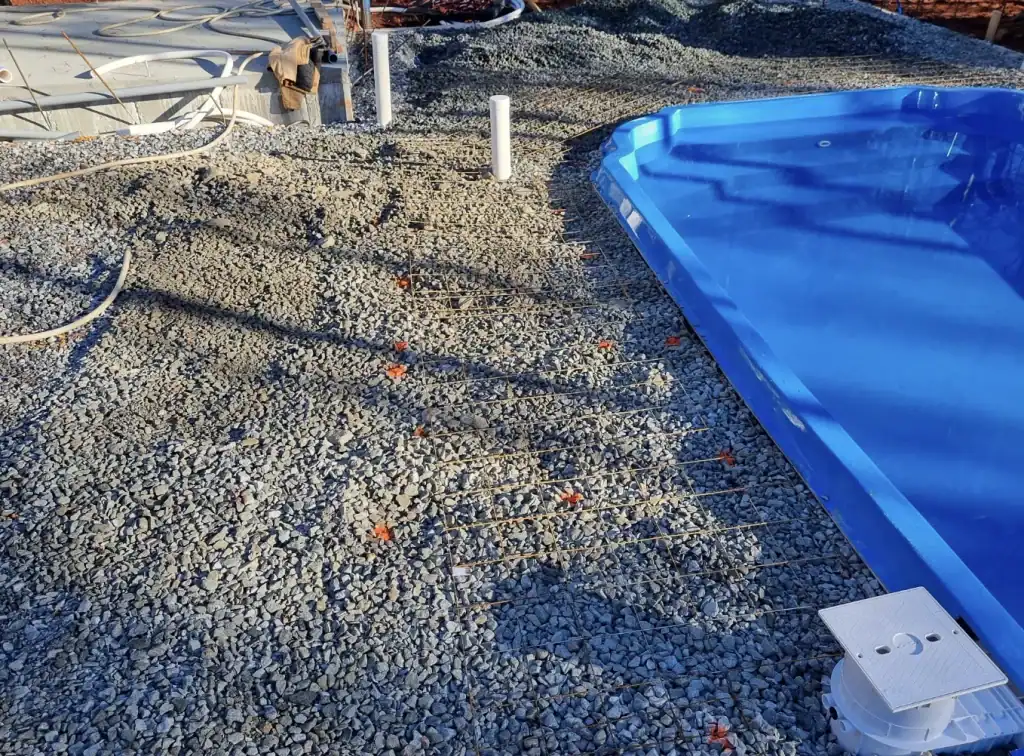
How rock actually shows up in a pool dig
“Rocky soil” covers three different situations, and they carry very different price tags.
- Scattered rock and cobbles. Fieldstones and boulders mixed through diggable soil. The excavator works around and through them, maybe grumbling, rarely charging much extra. Most “rocky” yards are this.
- Rippable rock. Weathered, fractured, or soft rock layers, shale, weathered limestone, decomposed granite, that a large excavator can tear loose with a ripper tooth without special equipment. Slower than dirt, cheaper than hammering.
- Hard rock and bedrock. Solid ledge that machines can’t rip. This is where hydraulic hammering enters, and in the hardest cases, blasting. It’s also where budgets break when nobody priced it beforehand.
The kicker: these can all live in the same county, sometimes the same street. A neighbor’s easy dig doesn’t guarantee yours, which is why assessment, not assumption, is the professional move.
Before anything else, know the sequence a normal install follows so you can see where excavation sits in it: see how your pool comes together from order through dig day to first swim.
Scoping the ground before the machines arrive
You have four assessment tools, in rising order of certainty and cost:
- The USDA Web Soil Survey. Free and immediate: websoilsurvey.sc.egov.usda.gov maps soil types and frequently flags shallow “depth to bedrock” for your exact parcel. Ten minutes here tells you whether to worry at all.
- Local knowledge. Excavators, well drillers, and builders who work your area know where the ledge runs. So do neighbors who’ve built additions, septic systems, or pools. Ask what they hit and at what depth.
- Your own yard’s history. Rock outcrops at the surface, a basement that required blasting when the house was built, fence posts that wouldn’t go in, all those things are evidence.
- Test holes. The gold standard: an excavator digs two or three exploratory holes along the pool footprint to actual depth before you sign anything. A few hundred dollars of machine time converts the biggest unknown in your project into a fact.
For a pool dig that typically needs 6’+ of depth, knowing what sits in those first several feet is the difference between a bid and a guess.
Hammering, blasting, and what they cost you
When assessment says rock, here’s what the methods actually involve.
Hydraulic hammering (a breaker attachment on the excavator) pulverizes hard rock a strike at a time. It’s the workhorse for residential pool rock: no permits beyond the normal ones, no evacuation radius, just slower progress billed by the hour or the cubic yard. Depending on how much of the hole is ledge, hammering commonly adds anywhere from a modest four-figure sum to $10,000+ to the excavation line.
Blasting is the specialist case for extensive solid bedrock where hammering would take too long to pencil. It’s a licensed, permitted, insured trade of its own, with seismic monitoring and neighbor notification in many jurisdictions, and it’s priced accordingly. Genuine residential pool blasting is uncommon; treat its appearance in a conversation as a signal to get a second opinion on the assessment, then a fixed, written price if it’s real.
Timeline effects are real but bounded. Rock can stretch dig day into dig week, and haul-off of broken rock adds trucking. But it moves the excavation phase, not the whole calendar’s character; once the hole exists, a fiberglass install proceeds at its usual pace, because the shell arrives from the factory as a finished pool and weeks of on-site construction become days of installation.
One silver lining worth knowing: broken rock is excellent, stable material, and sites cut into rock don’t settle the way loose fills do. A shell bedded on and backfilled with crushed stone in a rock-cut hole is sitting in some of the most stable ground a pool can occupy.
For where the excavation line sits among all the others, dig into our fiberglass pool installation cost guide; rock is the reason that guide treats excavation as a range instead of a number.
Budgeting honestly: the rock clause every quote needs
Here’s the part that protects you more than any machine choice.
A professional excavation quote in rocky country answers the rock question in writing, before the dig: what the base price assumes, what happens per hour or per cubic yard if rock is encountered, and who decides when the meter starts. The red flag is the opposite: a low bid with “site work additional” and no definitions, which converts every strike of the hammer into an open-ended change order you’ve already agreed to by default.
Three questions to ask any excavator, and any pool seller, in rocky country:
- “What does this price assume about rock, and what’s the rate if we hit it?”
- “Have you dug in this neighborhood, and what did you find?”
- “Will you dig test holes first, and what would that cost?”
Rock changes the excavation line, not the pool
Fiberglass shells start at $12,500, and total owner-builder projects typically run $30,000–$50,000, with heavy rock pushing a site toward, and occasionally past, the top of that range. The $10,000–$20,000+ you save vs. a full-service build by going manufacturer-direct is precisely the cushion that lets a rocky site absorb a hammering bill and still come out ahead.
If you’re weighing the owner-builder path, rock raises the stakes on your excavator hire, and that’s manageable. You’re choosing the subcontractor, so you can choose one with rock experience, demand the test holes, and hold the written rock clause. Our owner-builder installation guide walks through how the specs, documentation, and guidance support exactly these calls, and the same scoping discipline serves you if you choose a coordinated installation instead.
Frequently asked questions about pools in rocky soil
Can you install an inground pool in rocky soil?
Yes. Any residential rock can be excavated; the question is method and cost. Scattered rock digs out normally, weathered rock gets ripped by the excavator, and hard ledge gets hydraulically hammered, with true blasting a rare, specialist case. The key is assessing what’s under the footprint before pricing the dig.
How much does rock removal add to a pool excavation?
It ranges from almost nothing for scattered cobbles to $10,000+ where much of the hole is solid ledge requiring hammering, plus haul-off trucking for the broken rock. That’s why quotes in rocky country should define a written rock rate up front, and why test holes before contract are the cheapest insurance in the project.
How do I know if there’s bedrock under my yard?
Start free: the USDA Web Soil Survey maps depth-to-bedrock for most parcels. Add local evidence, outcrops, what neighbors hit building basements or septic systems, what area excavators expect. For certainty, have an excavator dig test holes along the pool footprint to full depth before you sign anything.
Is blasting ever needed for a residential pool?
Rarely. Hydraulic hammering handles the large majority of residential hard-rock digs. Blasting enters only for extensive solid bedrock where hammering can’t pencil, and it’s a licensed, permitted specialty with its own costs and procedures. If blasting comes up, get the assessment verified and the price fixed in writing.
Does rocky ground cause problems for the pool afterward?
Generally the opposite. Rock-cut sites don’t settle the way loose soils can, and a fiberglass shell set on a crushed-stone base in a rock excavation sits in extremely stable ground. The challenge with rock is the one-time cost of making the hole, not the decades that follow.
The bottom line on rocky-soil installs
Installing a pool in rocky soil is a scoping discipline, not a gamble. Learn what’s under the footprint before the machines arrive, get the rock rate in writing, and let ha
The next step is site-specific: request your free, no-obligation quote and we’ll help you scope the excavation questions for your ground, with a pre-dig evaluation plan, honest numbers, and both purchase paths on the table.
Latest Posts
From Order to First Swim: A Realistic Fiberglass Pool Timeline
Does a Pool Raise Your Homeowners Insurance? What to Expect
Installing a Fiberglass Pool in Rocky Soil: Excavation Realities
Fiberglass Pool Costs in Mississippi: Your Guide to Value and Savings
What Does a Fiberglass Pool Cost in Arkansas? Your Complete Guide
Florida Pool Installation Costs: Your Guide to Affordable Backyard Bliss
Protecting Your Backyard Oasis: Are In-Ground Pools Safe in Tornado Country?
Adding an Inground Pool in Hurricane-Prone Areas: Is It a Safe Investment for Your Family?
Adding a Pool to Your New Home Builds: A Builder’s Guide to Value and Efficiency
Ohio Pool Installation Guide: Costs, Timing, and What Homeowners Need to Know
Visit Our Blog
Share This Post
(opens in a new tab)
(opens in a new tab)
(opens in a new tab)