

August 25, 2026
/
In the natural swimming pool vs fiberglass decision, the trade is simple to state and hard to live with: a natural pool filters itself with plants and gravel instead of chlorine, but it demands roughly double the yard space, specialist maintenance, and tolerance for water that isn’t always crystal clear. A fiberglass pool keeps a small chemical footprint, roughly $350–$400 a year in upkeep, and predictable, swim-ready water.
Chemical-free swimming is a genuinely appealing idea. If you’ve watched a documentary about European swim ponds and started eyeing the back corner of your yard, you’re in good company (according to HGTV), and the eco instinct behind it is worth taking seriously.
The question for homeowners is what that idea costs in space, money, and Saturday mornings. This guide compares both eco pool options on footprint, natural pool cost drivers, upkeep hours, water quality, and realistic family use, so you can pick the pool your household will actually enjoy for decades.
Key Takeaways
- A natural swimming pool needs a regeneration zone, a plant-and-gravel filter bed that often takes up as much area as the swimming zone itself, roughly doubling the footprint.
- Natural pools are custom construction projects with few specialist builders in the US, so quotes vary widely and routinely land in premium custom-build territory.
- Fiberglass pools run roughly $350–$400 a year in maintenance, with shells starting at $12,500 and total owner-builder projects typically running $30,000–$50,000.
- Natural pools trade chlorine for ecosystem management: skimming, plant care, and seasonal balancing, with water clarity that shifts through the year.
- Fiberglass isn’t chemical-free, but its non-porous gel coat keeps chemical use low, and it pairs well with saltwater chlorination for a gentler swim.
What is a natural swimming pool, really?
A natural swimming pool, sometimes called a swim pond, splits your water into two zones. The swimming zone is the part you actually swim in. The regeneration zone is a shallow bed of gravel and aquatic plants that filters the water biologically, the way a healthy pond polices itself.
No chlorine, no traditional filter cartridges. Water circulates from the swim area through the plant zone, where microbes and roots consume the nutrients algae would otherwise feast on. When the ecosystem is balanced, the result is soft, living water with a wild-swimming feel.
That regeneration zone is also the catch. It’s not optional, and it often needs to be about as large as the swimming area itself. The ecosystem is doing the job a mechanical filter does in a conventional pool, and ecosystems don’t compress well.
A fiberglass pool takes the engineered path instead: a one-piece molded shell with a smooth, non-porous gel coat, a circulation pump, and a sanitizer keeping the water consistently clear. If you haven’t looked at modern shells yet, the range of fiberglass pool models now runs from an 8′ x 10′ plunge pool to 16′ x 42′ family pools with built-in tanning ledges.
The yard math most buyers miss
Before cost, before chemistry, check your lot line. Footprint is where many natural pool plans quietly end. Checking the conditions of your yard is essential for any type of installation, and with the size of natural pools in mind, this is a crucial step in understanding the space you’d need for one.
Because the regeneration zone commonly matches the swim zone in area, a natural pool with a modest 14′ x 28′ swimming area can occupy the ground of a pool twice that size. Add the naturalistic borders, boulders, and planting shelves that make the concept work visually, and the project wants a big chunk of your yard.
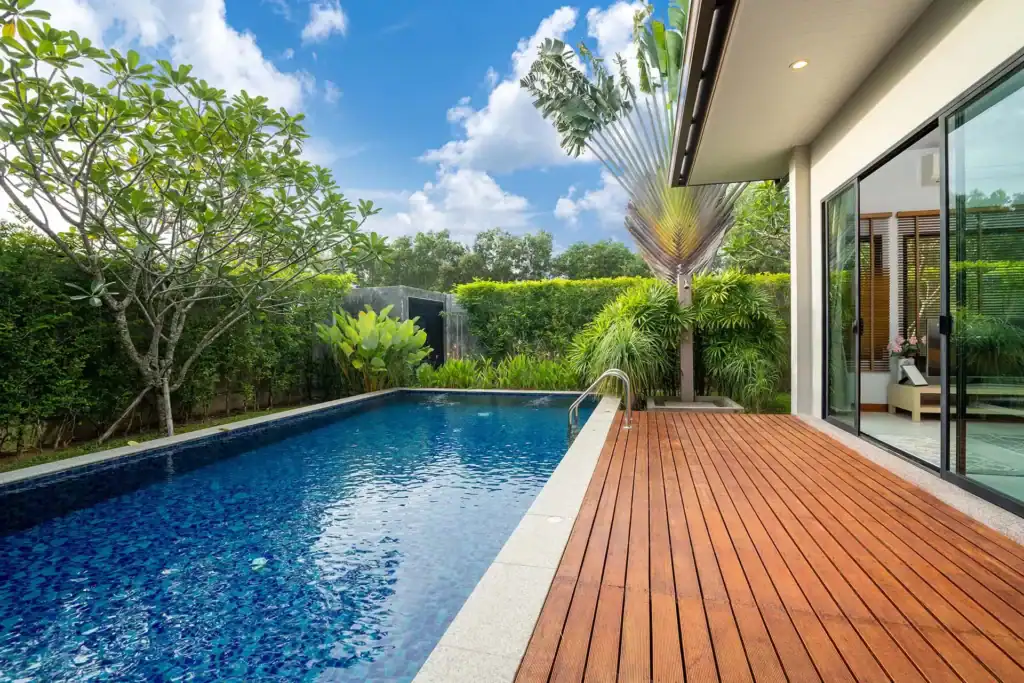
A fiberglass shell needs only its own footprint plus decking. The same 14′ x 28′ of swim space is, simply, 14′ x 28′. For typical suburban lots, that difference decides the question before any brochure does.
There’s a water consideration too. More surface area means more evaporation, and the US EPA’s WaterSense program has documented how much outdoor water use dominates a household’s total utility bill. A compact pool with a cover is the easier system to run lean and reduce issues with evaporation of your pool water.
What does a natural pool cost?
Natural pool cost is the hardest number in this comparison to pin down because each one consists of costs for a custom excavation, liner, plumbing, and landscape project – all designed around your soil, climate, and planting plan.
Specialist builders are still rare in the US, which means limited competition on pricing, travel costs for a professional installation team, and quotes that routinely land in premium custom-build territory, often beyond what a comparable conventional pool runs. You’re also buying two pools’ worth of excavation: the swim zone and the regeneration zone.
Fiberglass pricing, by contrast, is refreshingly public and transparent. Shells start at $12,500, and total owner-builder projects typically run $30,000–$50,000 depending on size, site conditions, and add-ons like heaters and covers. That owner-builder path saves $10,000–$20,000+ vs. a full-service build, and a coordinated installation through a vetted installer network is available if you’d rather stay hands-off.
Financing follows the same logic. A predictable, itemized fiberglass budget is straightforward to finance and compare. A custom ecosystem build is harder to quote, harder to compare, and harder to keep on budget once planting and stonework begin.
Neither number is “wrong.” One is a landscape commission; the other is a manufactured product with a published starting price. Just make sure the quote you fall in love with includes everything: excavation, plumbing, electrical, permits, and the plants.
Maintenance: gardening vs. water care
Here’s the part the beautiful photos don’t show: a natural pool replaces chemical maintenance with ecosystem maintenance, and an ecosystem keeps its own schedule.
Expect regular skimming, seasonal plant trimming and dividing, sediment management in the regeneration zone, and patience each spring while the biology wakes back up. Water clarity shifts through the year, clearer in cool months, greener in hot ones, and a stubborn imbalance can take weeks of adjustment, sometimes with a specialist’s help, because few local pool techs service living systems.
Some owners genuinely love that rhythm. If tending a water garden sounds like a hobby rather than a chore, that’s a real signal in the natural pool’s favor.
Fiberglass maintenance is lighter and more predictable: test and balance the water weekly, empty skimmer baskets, and brush occasionally. The non-porous gel coat gives algae nowhere to anchor, which is why fiberglass runs roughly $350–$400 a year vs. $1,000+ for vinyl and $2,000+ for concrete. The full routine fits in a short checklist, and it’s laid out in this guide to fiberglass pool maintenance.
The honest summary: a natural pool asks for hours in the garden, a fiberglass pool asks for minutes at the test strip.
The chemical-free question, answered honestly
If your goal is a truly chemical-free pool, the natural pool wins that category outright. There’s no chlorine in a balanced swim pond, and for swimmers with strong sensitivities, that can be decisive.
Fiberglass doesn’t pretend to be chemical-free. It’s low-chemical, and the distinction matters. The smooth gel coat surface resists the algae growth that drives heavy chemical dosing in porous concrete pools, so owners typically maintain clean water with modest, stable sanitizer levels.
Want gentler water without adopting an ecosystem? Saltwater chlorination pairs well with fiberglass shells. A salt system generates its own chlorine from dissolved salt, producing softer-feeling water with less chemical handling and storage, a popular middle path for eco-minded families. There are more levers too, covers, efficient pumps, and solar heating among them, covered in these eco-friendly pool solutions.
One more honest note: “natural” doesn’t automatically mean lower total impact. A large, uncovered water surface evaporates more, and pumps still circulate water all season. The greenest pool is the one sized sensibly, covered when idle, and run efficiently, whichever way it’s filtered.
Which eco pool option fits your family?
Both are solid choices, they just suit different households.
A natural swimming pool is right for you if:
- You have a large, sunny yard that can give up double the swim area
- You enjoy water gardening and want a living landscape feature
- Chemical-free water is a top priority, and variable clarity doesn’t bother you
- Your budget can absorb a custom, specialist-built project
A fiberglass pool is right for you if:
- Your yard, budget, or timeline can’t stretch around a regeneration zone
- You want clear, swim-ready water on a predictable $350–$400/yr routine
- Low-chemical operation (or a salt system) is green enough for your goals
- You’d rather your weekends go to swimming than ecosystem tending
Families weighing a wellness angle can also pair a fiberglass pool with a spa or standalone tanning ledge; the combinations are on the spas and accessories page.
The bottom line on natural swimming pool vs fiberglass
The natural swimming pool vs fiberglass choice comes down to what “eco” means for your family. If it means a living pond ecosystem and chlorine-free water, and you have the yard, the budget, and the gardener’s patience for it, a natural pool is a beautiful commitment. If it means low chemical use, low water and energy waste, and a pool that’s actually swim-ready every Saturday, fiberglass delivers that for roughly $350–$400 a year, with shells from $12,500 and total projects typically in the $30,000–$50,000 range.
Either way, the right pool is the one that fits your yard and your life, not just your Pinterest board.
If the practical-green path sounds like yours, request a free quote and we’ll walk you through models, salt-system-friendly setups, and honest total project numbers for your area.
The bottom line: fiberglass is more practical than a natural swimming pool
The natural swimming pool vs fiberglass choice comes down to what “eco” means for your family. If it means a living pond ecosystem and chlorine-free water, and you have the yard, the budget, and the gardener’s patience for it, a natural pool is a beautiful commitment.
If it means low chemical use, low water and energy waste, and a pool that’s actually swim-ready every Saturday, fiberglass delivers that for roughly $350–$400 a year, with shells from $12,500 and total projects typically in the $30,000–$50,000 range.
Either way, the right pool is the one that fits your yard and your life, not just your Pinterest board.
If the practical-green path sounds like yours, request a free quote and we’ll walk you through models, salt-system-friendly setups, and honest total project numbers for your area.
Frequently asked questions
Is a natural swimming pool cheaper than a fiberglass pool?
Usually not. Natural pools are custom projects that excavate and build two zones, swim and regeneration, with few specialist builders competing for the work, so quotes often land well above conventional pools. Fiberglass shells start at $12,500, with total owner-builder projects typically running $30,000–$50,000.
How much space does a natural swimming pool need?
Plan on roughly double the swimming area. The regeneration zone that filters the water biologically often needs to be about as large as the swim zone itself, plus naturalistic borders and planting. A fiberglass pool needs only its own footprint and decking.
Are natural swimming pools hard to maintain?
They’re differently hard. You trade water testing for ecosystem care: skimming, plant trimming, sediment management, and seasonal rebalancing, with water clarity that varies through the year. Owners who love gardening often enjoy it. Owners who want predictable, clear water usually don’t.
Can a fiberglass pool be chemical-free?
No, and honest sellers say so. Fiberglass is low-chemical: the non-porous gel coat resists algae, so sanitizer needs stay modest, and saltwater chlorination can make the water feel softer still. Only a balanced natural pool is truly chlorine-free.
Do natural pools have clear water?
Not always, and that’s by design. Living water shifts with temperature, nutrients, and season, running clearer in cool months and greener in warm ones. A well-balanced system stays pleasant, but it will never match the consistent clarity of a sanitized, filtered pool.
Is a fiberglass pool an eco-friendly choice?
It can be a strong one. Fiberglass holds heat efficiently, uses fewer chemicals than porous-surfaced pools, and its compact footprint limits evaporation, especially under a thermal blanket. Sized sensibly and run with an efficient pump, it’s a defensible green choice without the space demands of a swim pond.
Latest Posts
The Fiberglass Pool Installation Process, Step by Step
Budgeting for a Fiberglass Pool: Every Cost Beyond the Shell
Saltwater Pools: Why Fiberglass Handles Salt Better Than Concrete
Delivery Day Checklist: How to Inspect Your Fiberglass Pool Shell
How Much Time Does Pool Maintenance Really Take?
Shipping Container Pools or Fiberglass: Which Is Better?
Fiberglass vs. Natural Swimming Pools: A Practical Cost and Maintenance Comparison
Fiberglass vs. Gunite Pools: How Construction Method Shapes Lifespan and Care
Shell Price vs. Total Project Cost: Reading a Fiberglass Pool Quote
The Fiberglass Pool Buying Guide for First-Time Buyers
Visit Our Blog
Share This Post
(opens in a new tab)
(opens in a new tab)
(opens in a new tab)