

Congratulations, you’re in the market for a pool! Buyers compare purchase prices for months and never once compare Saturdays. Yet the weekly routine is the price you pay every single week, for decades, in the currency you can’t refinance: your time.
Here’s the pool maintenance comparison most buyers never see: plan on roughly 30–45 minutes a week for a fiberglass pool, closer to an hour a week for vinyl, and one to two hours or more for concrete, whose porous plaster demands regular brushing of every underwater surface. On the money side, annual upkeep runs roughly $350–$400 for fiberglass vs. $1,000+ for vinyl and $2,000+ for concrete.
This guide breaks down what every pool needs, what each pool type adds to the mix, realistic weekly hours, and annual chemical costs side by side — and which routine actually fits your life. Because the easiest pool to maintain is also the one you’ll enjoy the longest.
Key Takeaways
- Realistic weekly upkeep: roughly 30–45 minutes for fiberglass, about an hour for vinyl, and one to two-plus hours for concrete, driven mostly by surface brushing needs.
- Annual maintenance costs follow the surface: fiberglass roughly $350–$400/yr vs. vinyl $1,000+/yr and concrete $2,000+/yr.
- The non-porous gel coat is the reason fiberglass wins the time war: algae can’t anchor, so brushing is occasional instead of mandatory.
- Concrete’s porous plaster requires weekly wall-and-floor brushing plus heavier chemical dosing; vinyl needs gentler tools and constant liner vigilance.
- Every pool still needs the basics weekly: skim, empty baskets, test and balance water, and run the pump; no surface exempts you from chemistry.
The cost nobody quotes: your Saturday mornings
A pool quote lists the shell, the equipment, the decking. It never lists the 100+ hours a year that some pools quietly bill their owners.
The difference between a 30-minute maintenance routine and a two-hour routine (run weekly across a long swim season) is entire weekends of your summer. Multiply that time by the 25+ years a quality pool lasts, and the time gap between pool types makes price considerations look different.
The good news: the time cost is predictable before you buy. Maintenance planning must include consideration of the pool’s surface, because the surface decides whether algae gets a grip. Rough and porous (like concrete or gunite) means scrubbing; smooth and non-porous (like fiberglass) means skimming and testing.
What every pool needs weekly
No pool is maintenance-free, and anyone who claims otherwise is selling something. Every residential pool needs this baseline routine:
- Skim debris and empty skimmer baskets.
- Test the water and balance pH, alkalinity, and sanitizer.
- Run and check the pump and filter.
- Glance at the waterline and equipment for anything off.
Water testing isn’t optional; the CDC’s Healthy Swimming guidance ties safe water directly to maintained chemistry. Budget 20–30 minutes weekly for these basics on any pool.
Everything beyond that baseline depends on the surface, and that’s where the three pool types part ways.
Concrete pools: the brushing schedule that never ends
Concrete and gunite pools wear a plaster finish, and plaster is porous. Those microscopic pores are anchor points for algae, which is why the standard care advice for concrete pools includes brushing the walls and floor weekly, all of them, every week.
Brushing an entire pool interior is genuine exercise, and it’s the single biggest reason concrete owners’ weekly routines stretch to one to two hours or more. The porosity also drinks sanitizer, so chemical dosing runs heavier, and plaster’s chemistry interacts with water balance in ways that demand closer attention.
Then come the scheduled extras: periodic acid washing to strip stains and buildup, and resurfacing roughly every decade as the plaster wears. Those aren’t weekly hours, but they’re real ownership costs that belong in the comparison, and they’re a big part of the $2,000+ annual figure for concrete upkeep.
None of this makes concrete a bad pool. It makes concrete a pool for owners who’ve budgeted honestly for its care, or for a service contract.
Vinyl liner pools: gentler care, constant vigilance
Vinyl sits in the middle, and its routine is less about muscle than about caution.
The liner surface is smoother than plaster, so algae has a harder grip and brushing is lighter duty. But everything touching the liner must be gentle: soft brushes only, careful vacuuming, no aggressive tools, because the liner is thin and a puncture or tear is a real repair. Wrinkles, fading, and stretching need watching, and the waterline collects buildup that wants regular, careful attention.
Chemistry matters extra for vinyl: unbalanced water shortens liner life, and the liner is the pool’s wear item, with replacement (and additional costs) every several years as part of ownership. That vigilance plus the liner cycle is why vinyl’s annual upkeep runs $1,000+ even though the weekly routine, at roughly an hour, is manageable.
Vinyl’s honest assessment: moderate time, gentle hands, and a recurring liner bill.
Fiberglass pools: why the gel coat does the work
Fiberglass pool maintenance time is short for one unglamorous reason: the gel coat surface is non-porous, so algae has nowhere to anchor. The scrubbing other pools require simply has no job to do.
A typical week is the shared baseline and little else: skim, empty baskets, test and balance, confirm the pump’s happy — all of that can happen in 30–45 minutes. Brushing is an occasional touch-up, not a workout. Chemical use stays low and stable because nothing on the surface is fighting the sanitizer, which is how fiberglass lands at roughly $350–$400 a year vs. $1,000+ for vinyl and $2,000+ for concrete.
There’s no liner to take special care of and no resurfacing cycle to save for; the gel coat is engineered to last the life of a shell that typically serves 25+ years, with many pools lasting longer with proper care. The complete weekly and seasonal routine is laid out in this fiberglass pool maintenance guide.
Honesty requires the flip side too: fiberglass isn’t maintenance-free or problem-free, and the known issues about fiberglass (and how to avoid them) are covered in fiberglass pool problems explained.
Something all pool owners should also consider is the season where you’re likely not swimming: winter. Unless you have a heater, your pool will close at leat 3-4 months of the year. Keeping that in mind, consider what you can do during that time to maintain the pool so there’s less work to do come summer.
And if you’re looking at our fiberglass pool models and considering the addition of a hot tub, we have a guide for that too. Our hot tub tips can give you additional information to plan for your spa, too.
The comparison at a glance: hours and dollars
Here’s the whole pool maintenance comparison in one table, using realistic planning figures:
| Pool type | Typical weekly time | Annual upkeep cost | The big extras |
|---|---|---|---|
| Fiberglass | ~30–45 minutes | ~$350–$400 | None scheduled; gel coat lasts the shell’s life |
| Vinyl liner | Around an hour | $1,000+ | Liner replacement every several years |
| Concrete/gunite | One to two-plus hours | $2,000+ | Acid washing; resurfacing roughly every decade |
Read this table as a lifestyle question, not just a budget line. A low maintenance pool means Saturday mornings in the water instead of beside it with a brush. Over a decade, the time and money gap can fund the heater, the safety cover, and a family vacation, and that’s before counting the hours.
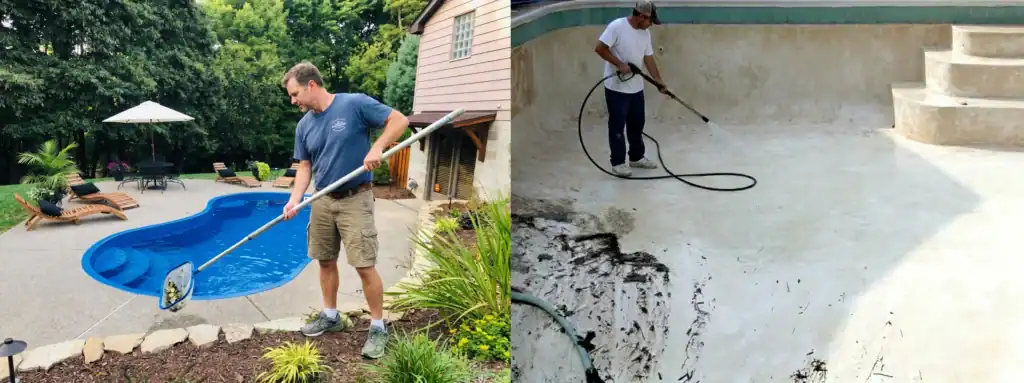
Which routine fits your life?
Concrete is right for you if: you want fully custom geometry and you can budget the brushing hours or a service contract that covers them.
Vinyl is right for you if: the lower entry price matters most and you’re comfortable with careful handling and a liner replacement cycle.
Fiberglass is right for you if: you want the easiest pool to maintain, a stable $350–$400 annual routine, and weekends that belong to swimming. Browse fiberglass pool models from 8′ x 10′ plunge pools to 16′ x 42′ family pools.
Whichever way you lean, run the numbers for your own situation; the full cost breakdown lives in this FAQ on the cost of maintaining a pool.
The bottom line on the pool maintenance comparison
Buy the pool whose maintenance days you can tolerate, not just the days where you enjoy swimming in it.
If the short-routine pool sounds like your speed, request a free quote and we’ll match you with models and honest total project numbers, so the only thing left to schedule is the first cannonball.
Frequently asked questions
What is the easiest pool to maintain?
Fiberglass, by a comfortable margin. Its non-porous gel coat gives algae nowhere to anchor, so the routine is mostly skimming, testing, and balancing, roughly 30–45 minutes a week, with annual costs around $350–$400 vs. $1,000+ for vinyl and $2,000+ for concrete.
How many hours a week does pool maintenance take?
Plan on roughly 30–45 minutes for fiberglass, about an hour for vinyl, and one to two-plus hours for concrete, where weekly brushing of all underwater surfaces drives the time. Every pool shares a 20–30 minute baseline of skimming, testing, and equipment checks.
Why do concrete pools take so much more work?
Their plaster surface is porous, giving algae anchor points that demand weekly brushing of walls and floors, plus heavier sanitizer use. Concrete also adds scheduled projects: acid washing and resurfacing roughly every decade as the plaster wears.
Are fiberglass pools really low maintenance?
Yes, low, but not zero. You’ll still skim, test, and balance weekly like any pool owner. What disappears is the labor other surfaces demand: no mandatory brushing regimen, no liner to baby, and no resurfacing cycle, which is how upkeep stays near $350–$400 a year.
Latest Posts
The Fiberglass Pool Installation Process, Step by Step
Budgeting for a Fiberglass Pool: Every Cost Beyond the Shell
Saltwater Pools: Why Fiberglass Handles Salt Better Than Concrete
Delivery Day Checklist: How to Inspect Your Fiberglass Pool Shell
How Much Time Does Pool Maintenance Really Take?
Shipping Container Pools or Fiberglass: Which Is Better?
Fiberglass vs. Natural Swimming Pools: A Practical Cost and Maintenance Comparison
Fiberglass vs. Gunite Pools: How Construction Method Shapes Lifespan and Care
Shell Price vs. Total Project Cost: Reading a Fiberglass Pool Quote
The Fiberglass Pool Buying Guide for First-Time Buyers
Visit Our Blog
Share This Post