

July 23, 2026
/
In the fiberglass vs concrete cold climate matchup, physics picks a favorite: a one-piece fiberglass shell has enough flex to ride the ground movement that freeze–thaw cycles cause, while rigid concrete resists that movement until it cracks. Both pools can live long lives up north with proper engineering and winterization, but fiberglass carries a built-in margin for error that concrete has to buy with maintenance.
If you’re shopping for a pool in Ohio, Indiana, Maryland, or West Virginia, summer heat isn’t your durability test. Your pool’s hardest season is the one when nobody’s swimming.
This guide walks through what freeze–thaw actually does to the ground, how each construction handles it, what winterization each pool demands, and which pool makes sense for northern states. The physics is simple; the ownership consequences run for decades.
Key Takeaways
- Freeze–thaw cycles swell and settle the soil around a pool all winter long; that repeated ground movement, not cold water, is the real durability threat up north.
- Rigid concrete resists ground movement until it cracks or spalls, and freeze thaw pool damage on plaster accelerates the acid-wash and resurfacing schedule.
- A fiberglass shell flexes slightly with the moving ground, which is why fiberglass pools typically last 25+ years, with many lasting 30–50 with proper care, even in frost country.
- Either pool needs cold-climate engineering: a crushed-stone base, perimeter drainage, and correct winterization are non-negotiable.
- Fiberglass also holds heat better than concrete, so the heater works less during the shoulder seasons that bookend a northern swim year.
Why freeze-thaw is the real durability test up north
Here’s what winter actually does to a pool, and it has little to do with ice on the surface.
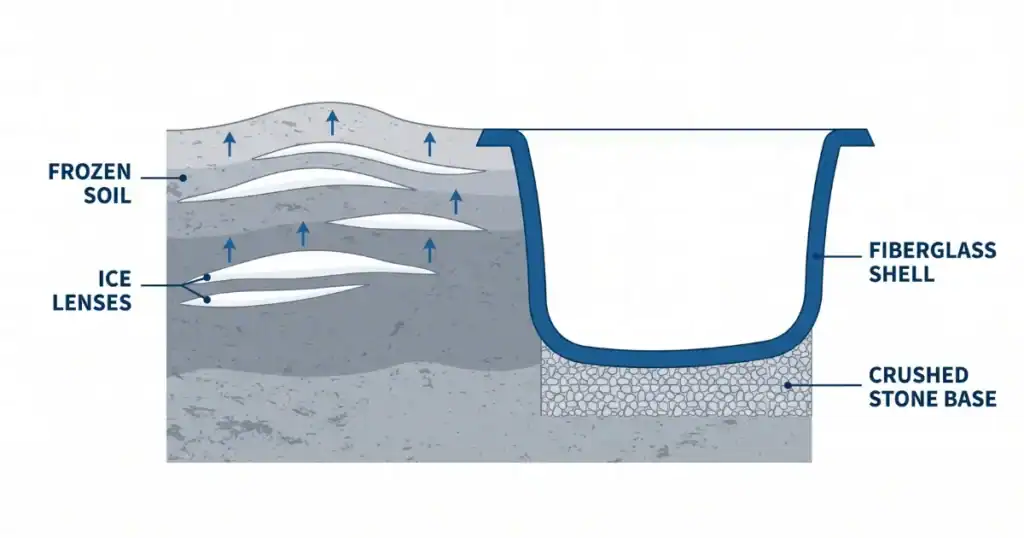
Soil holds moisture. When that moisture freezes, it expands, and the ground swells upward and sideways; this is frost heave. When it thaws, the ground settles back. Across a northern winter, that swell-and-settle cycle repeats dozens of times, and every cycle pushes on whatever’s buried in the ground, including your pool shell.
How deep the ground freezes varies by region, which is why building codes set frost-line depths locally and the National Weather Service tracks freeze conditions all winter. The engineering question isn’t whether the ground around a northern pool will move. It will. The question is what your pool does about it.
That’s the whole comparison in one sentence: concrete resists movement, fiberglass accommodates it.
What freeze-thaw does to a rigid concrete shell
Concrete’s superpower is compressive strength; its weakness is that it doesn’t bend. When frost heave pushes unevenly against a rigid gunite or concrete structure, stress concentrates until something gives, and what gives is the concrete: hairline cracks that grow, and surface spalling, where flakes of plaster or concrete pop loose as water in the material freezes.
Freeze thaw pool damage on concrete compounds over many season cycles. Water seeps into small cracks, freezes, expands, and wedges them wider each cycle. Cold climates also stack the deck against plaster generally: the surface that already needs acid washing and resurfacing roughly every decade tends to reach those appointments sooner where winters bite.
None of this means concrete pools can’t survive up north; well-engineered ones do. It means their northern owners carry a standing crack-watch, a repair budget, and an earlier resurfacing calendar as the cost of rigidity. Honest concrete builders say the same.
Fairness note: concrete keeps its custom-geometry crown in any climate. The full comparison beyond winter lives in this fiberglass vs. concrete pool breakdown.
Why fiberglass flexes instead of fighting
A one-piece fiberglass shell approaches the same moving ground with different physics. The composite material has a slight, engineered give, enough to flex with frost heave the way a dock rides waves, then return to shape as the ground settles.
Fiberglass flexes. Concrete cracks. That’s the cold-climate story in four words, and it’s why fiberglass pools typically last 25+ years, with many lasting 30–50 years with proper care, even where winters are serious.
Flexibility isn’t a license to skip engineering. A proper cold-climate install pairs the shell with a crushed-stone base, the recommended bedding that drains water and resists frost movement beneath the pool, and perimeter drainage that keeps groundwater from pooling against the shell. Specs and documentation for both come standard with every cold-climate project, engineered for local soil and frost lines.
There’s a comfort bonus, too: fiberglass holds heat better than concrete, so shoulder-season swims in April and October cost less to heat. The deeper cold-climate case, including why the gel coat shrugs off winter chemistry, is in this guide to fiberglass pools in cold climates.
Winterization: protecting either pool the right way
Whichever shell you choose, winterization is where northern pools are won or lost. The honest checklist:
- Balance the water before closing; bad chemistry works all winter.
- Blow out plumbing lines and add pool-grade antifreeze where appropriate.
- Insulate or drain exposed equipment: pump, filter, heater.
- Set the water level per your pool type’s guidance.
- Cover with a fitted winter or safety cover, anchored to handle snow.
Two type-specific notes. Concrete owners should inspect for new cracks at closing and opening, because winter turns small flaws into bigger ones. Fiberglass owners should never fully drain the shell; groundwater pressure is the one winter force that can genuinely hurt a fiberglass pool, and staying filled is the defense.
Done right, closing is an afternoon, and the spring opening is a rinse-and-test rather than a repair estimate. The full routine is in this winter pool maintenance guide.
The northern states question: Ohio, Indiana, Maryland, West Virginia
“Can I even have a pool here?” is the question behind every northern search, and the answer is a confident yes, with the right construction.
A pool for northern states earns its keep in three ways: surviving freeze–thaw (fiberglass’s flex advantage), closing and opening cheaply (simple winterization, no crack inspection anxiety), and squeezing the most from a shorter season (thermal efficiency plus an optional heater and cover package). Fiberglass checks all three boxes, which is why it’s the workhorse choice across the Midwest and Mid-Atlantic.
Regional details matter, though: frost-line depths, county permit rules, and soil types all shift the install plan. Ohio buyers can start with the Ohio pool delivery page for state-specific guidance; similar support exists for Indiana, Maryland, West Virginia, and the rest of the service area, with permits and code expertise built into every project’s documentation.
The one-line takeaway for northern shoppers: don’t let winter talk you out of a pool. Let it talk you into the right shell.
Which pool wins winter?
Concrete in a cold climate is right for you if:
- Fully custom geometry is worth a standing crack-watch and repair budget
- You’ve priced the accelerated acid-wash and resurfacing schedule honestly
- You have (or will hire) diligent seasonal inspection habits
Fiberglass in a cold climate is right for you if:
- You want the shell that flexes with frost heave instead of fighting it
- The best pool for cold climate ownership, to you, means low drama: 25+ year typical lifespan and roughly $350–$400 a year in upkeep
- You’d rather spend on a heater and cover than on crack repair
- Swimming by early summer matters; factory-molded shells install in days, not construction seasons
Either way, insist on cold-climate engineering: crushed-stone base, perimeter drainage, and a winterization plan in writing.
Frequently asked questions
What is the best pool for cold climates?
Fiberglass, for most northern families. Its one-piece shell flexes with freeze–thaw ground movement instead of cracking, its gel coat needs no resurfacing, and it holds heat better than concrete, all of which matter in states like Ohio, Indiana, Maryland, and West Virginia.
Does freeze-thaw damage concrete pools?
It’s the leading winter risk. Frost heave pushes unevenly on the rigid structure, concentrating stress into cracks, and freezing water widens them each cycle while plaster surfaces spall. Well-engineered concrete pools manage the risk, but northern owners inherit inspection and repair routines.
Will a fiberglass pool crack in the winter?
Properly installed, no; the shell flexes with the moving ground instead of resisting it. The keys are a crushed-stone base, perimeter drainage, and correct winterization, including keeping the pool filled so groundwater pressure can’t stress an empty shell.
Do I need to winterize a fiberglass pool in northern states?
Yes. Balance the water, blow out the lines, protect the equipment, and anchor a fitted cover. It’s an afternoon of work that protects decades of shell life, and it’s far simpler than the close-and-inspect routine a concrete pool asks for.
Can you install a fiberglass pool where the ground freezes deep?
Yes, that’s exactly what cold-climate fiberglass installs are engineered for. The crushed-stone base and perimeter drainage manage water and frost movement below the shell, and project specs are matched to local soil and frost-line depths, with permit guidance included.
Final thoughts on fiberglass vs concrete in cold climates
The fiberglass vs concrete cold climate contest is decided by what each material does when the ground moves, and the ground will move. Concrete resists until it cracks and spalls, then bills you for patches and earlier resurfacing. Fiberglass flexes with the freeze–thaw cycle, backed by a crushed-stone base and perimeter drainage, and gets back to hosting cannonballs every spring for 25+ years, typically at roughly $350–$400 a year in upkeep.
Winter is a fine place to own a pool. It’s just a bad place to own a brittle one.
Planning a pool in the Midwest or Mid-Atlantic? Browse the winter-ready fiberglass pool models, then request a free quote and we’ll walk you through cold-climate installation guidance and honest total project numbers for your state.
Latest Posts
The Fiberglass Pool Installation Process, Step by Step
Budgeting for a Fiberglass Pool: Every Cost Beyond the Shell
Saltwater Pools: Why Fiberglass Handles Salt Better Than Concrete
Delivery Day Checklist: How to Inspect Your Fiberglass Pool Shell
How Much Time Does Pool Maintenance Really Take?
Shipping Container Pools or Fiberglass: Which Is Better?
Fiberglass vs. Natural Swimming Pools: A Practical Cost and Maintenance Comparison
Fiberglass vs. Gunite Pools: How Construction Method Shapes Lifespan and Care
Shell Price vs. Total Project Cost: Reading a Fiberglass Pool Quote
The Fiberglass Pool Buying Guide for First-Time Buyers
Visit Our Blog
Share This Post
(opens in a new tab)
(opens in a new tab)
(opens in a new tab)