

June 16, 2026
/
The cost of heating a pool isn’t determined by the heater alone. What you’ll spend each month also depends on your climate, your cover habits, and even the material your pool is built from.
Pool heat pumps are one of the most economical options for homeowners who want to extend their swim season without the fuel costs that come with gas. They use electricity to move heat from the outdoor air into the water rather than burning fuel to generate it, which is why operating costs are typically much lower than gas.
Key Takeaways
- Pool heat pumps transfer heat from outdoor air into pool water rather than generating it from scratch. They deliver three to six times more heat per unit of electricity than a standard electric resistance heater, and their annual operating costs are typically much lower than gas.
- Total installed cost ranges from roughly $2,500 to $8,500 depending on unit size and electrical work. Monthly operating costs typically run $50 to $150.
- Efficiency drops when outdoor air falls below about 50°F. Below that, the unit still heats, but it works harder and recovery takes longer.
- Fiberglass pools generally lose less heat through the shell than concrete, so the heat pump runs fewer hours and costs less per month. In some cases, homeowners can select a smaller unit than a similarly sized concrete pool would require.
- With basic annual maintenance, a heat pump typically lasts 10 to 15 years, compared to five to ten for a gas heater.
How Pool Heat Pumps Work
A pool heat pump runs on the same refrigerant cycle as your home air conditioner, just in reverse. Your AC pulls heat out of your house and dumps it outdoors. A pool heat pump pulls heat from the outdoor air and transfers it into your pool water. Even air that feels cool contains enough thermal energy to run the refrigerant cycle efficiently.
A fan draws outdoor air across an evaporator coil. Liquid refrigerant inside the coil absorbs heat from that air and vaporizes. A compressor raises the pressure and temperature of the gas.
That hot gas then flows through a heat exchanger where pool water circulates on the other side. Heat passes into the water, warming it a few degrees per pass. The refrigerant cools back to liquid and the cycle repeats until the pool reaches your target temperature.
Efficiency is measured by a rating called COP (Coefficient of Performance). Most pool heat pumps run a COP between three and six, so one dollar of electricity delivers three to six dollars’ worth of heat. A standard electric resistance heater sits at a COP of 1.0, which makes a heat pump several times more efficient at turning electricity into pool heat.
Gas heaters use a different measure entirely, converting about 80 to 83% of fuel energy into heat, so COP and combustion efficiency don’t compare directly. In day-to-day operation, a heat pump runs significantly cheaper than gas in most climates. The U.S. Department of Energy covers the efficiency math in detail.
Are Pool Heat Pumps Worth It?
Homeowners who plan to keep the pool heated consistently through the swim season will often find a heat pump to be the most economical long-term option.
A heat pump costs more upfront than many gas heaters, but it costs substantially less to run. Heat pumps tend to make the most sense when you want to maintain a consistent water temperature rather than heating from cold for occasional use. They work best when you swim several times a week and when outdoor temperatures stay above 50°F through most of your swim season.
A gas heater may be the better fit if you only heat the pool for specific weekends or events and need rapid temperature increases on short notice.
Many homeowners focus on heater size before addressing heat loss. A quality pool cover used consistently overnight often does more for monthly costs than upgrading to a larger unit.
What Pool Heat Pumps Cost
Equipment cost depends on capacity, measured in BTUs per hour. Bigger pools and cooler climates need higher-capacity units.
- 85,000 BTU (small pools, under 12,000 gallons): $1,500 to $3,000
- 110,000 BTU (mid-size pools, 12,000 to 18,000 gallons): $2,500 to $4,500
- 125,000 to 140,000 BTU (large pools, 18,000+ gallons): $3,500 to $5,500
Installation runs $800 to $2,200 for the concrete pad, plumbing tie-in, and electrical connection. The unit requires a dedicated 240V/50A circuit. If your panel has room, adding the breaker and running wire costs $300 to $600. A panel upgrade adds another $600 to $1,800.
Total installed cost for most residential pools falls between $2,500 and $8,500. The ranges above reflect manufacturer published pricing and current market data as of early 2026.
Running a mid-size pool four to eight hours a day during swim season costs $50 to $150 a month at typical residential rates. Over a full season, heat pump owners typically spend $600 to $1,200 annually, while gas heater owners running a similar pool spend considerably more. After a few seasons, the lower monthly operating cost typically makes up the difference in upfront price.
Request a quote if you’d like help sizing the right unit for your pool.
Pool Heat Pump vs. Gas Heater
| Factor | Heat Pump | Gas Heater |
| Upfront Cost | Higher ($2,500 to $8,500 installed) | Lower ($1,500 to $4,500 installed) |
| Monthly Operating Cost | Lower ($50 to $150) | Higher ($200 to $400+) |
| Heating Speed | Slower (one to two days from cold) | Faster (a few hours from cold) |
| Cold Weather Performance | Efficiency drops below ~50°F | Full output in any temperature |
| Best Climate | Warm to moderate | Any climate |
| Typical Lifespan | 10 to 15 years | 5 to 10 years |
| Best For | Maintaining consistent temperature | Rapid on-demand heating |
After weighing the two, see the gas and electric pool heater options Pool Brokers USA offers to find the fit for your climate and usage.
Fixed-Speed vs. Inverter Models
A fixed-speed heat pump runs at full capacity or shuts off completely. When water temperature drops below the setpoint, the unit runs at 100% until the target is reached, then cycles off. These units cost $1,500 to $3,500 installed and work well in warmer climates where heating cycles are short.
The tradeoff is noise. A fixed-speed unit at full output runs about 60 to 65 decibels, similar to a window air conditioner.
An inverter heat pump adjusts compressor speed continuously to match the demand. It runs quieter, at roughly 50 to 55 decibels, and holds temperature more precisely. It also uses less electricity because it avoids the energy-intensive startup cycles of constant on-and-off cycling. Inverter units cost $3,000 to $5,500 installed.
Homeowners prioritizing lower noise and long-term efficiency will generally find inverter models the better investment. If your equipment pad sits near a patio, bedroom window, or property line, the difference in noise alone can be meaningful. In warmer climates where heating costs are already low, a fixed-speed unit is a practical choice. Some inverter models also include a cooling mode that lowers water temperature during peak summer, helping keep water comfortable when temperatures climb into the upper 80s and 90s.
Climate and Seasonal Fit
A heat pump’s output is tied to outdoor air temperature. The DOE notes that efficiency holds well down to about 45 to 50°F. Below that, capacity drops and recovery slows.
That makes a heat pump a strong fit across most of Pool Brokers USA’s service area. It runs close to year-round in the Southeast and Gulf states. In Virginia and the mid-Atlantic, a pool cover supports a dependable April through October season.
To stretch the season further in cooler months, many homeowners pair a heat pump with a smaller gas heater. The heat pump carries the daily load. The gas heater handles cold mornings or a rapid warm-up before a weekend gathering.
Why Heat Pumps Work Especially Well With Fiberglass Pools
Fiberglass is less thermally conductive than concrete. It loses heat to the surrounding ground more slowly. A concrete pool’s porous surface and direct soil contact let heat escape steadily through the shell. A fiberglass shell acts more like an insulated container.
In practice, that means a fiberglass pool holds its temperature longer overnight and needs fewer hours of heat pump runtime to stay comfortable the next day. Together, a properly sized heat pump, a fiberglass shell, and a consistently used cover can outperform a larger unit on a concrete pool that loses heat to the ground.
Depending on conditions like soil type, sun exposure, and cover usage, some homeowners find they can select a smaller-capacity heat pump than they’d need for a concrete pool of similar volume. That lowers the equipment cost and reduces the monthly electricity draw for the life of the unit.
Installation and Maintenance
Pool Brokers USA offers both owner-builder support and fully installed solutions. We help homeowners choose and size heaters alongside their fiberglass pools across the mid-Atlantic and Southeast.
Heating performance depends on pool volume, climate, exposure, and cover usage. So we size heat pumps alongside the overall pool design rather than as a separate equipment decision. Adding one to an existing fiberglass pool is typically a one-day job for the trades involved.
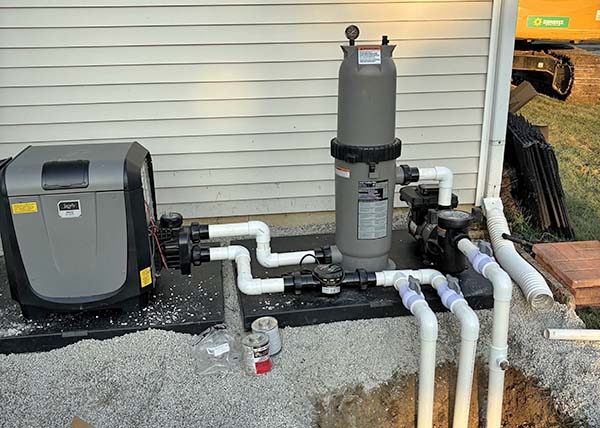
The unit sits on a level pad at least three to five feet from the pool edge. It connects into the circulation loop after the filter and before any chlorinator. A licensed electrician runs the dedicated 240V/50A circuit.
Give the unit at least 24 inches of clearance on all sides and an open top. Restricted airflow reduces efficiency and shortens the unit’s life. Check local noise ordinances before finalizing pad placement.
Maintenance is light. Rinse the evaporator coils with a garden hose once or twice a season to clear debris. Inspect electrical connections annually, especially on saltwater systems. Have a professional check refrigerant every few years.
Avoid running the unit for extended periods when outdoor temperatures drop below 40°F. When you close the pool, follow the manufacturer’s winterization instructions.
When shopping for a unit, check the heat exchanger material in the spec sheet. Titanium resists corrosion from pool chemicals and saltwater far better than copper or cupronickel. Heat exchanger warranties typically run about five years. Compressor warranties vary from a couple of years on fixed-speed models up to seven on some inverter units.
A well-maintained heat pump lasts 10 to 15 years. Our guide to pool heaters and swim season extension covers all heater types if you want a broader comparison.
Frequently Asked Questions
How long does a pool heat pump take to heat a pool?
A mid-size pool starting at 60°F and targeting around 82°F typically takes one to two days of continuous run time with a properly sized heat pump. Smaller pools on warm days reach temperature faster. Heat pumps are built to maintain temperature steadily rather than heat a cold pool in a few hours before a party. If rapid heat-up is the priority, a gas heater or dual-fuel setup is more practical.
What size pool heat pump do I need?
Sizing depends on pool volume, the temperature rise you need, and how long your swim season runs. A rough rule is that most pools need about 50,000 to 70,000 BTUs per 10,000 gallons, sized toward the higher end for cooler climates or spring and fall use. As a practical guide, a small pool usually takes an 85,000 BTU unit, a medium pool a 110,000 BTU unit, and larger pools 125,000 to 140,000 BTU.
Wind exposure, shade, and whether you use a cover also affect the calculation. A pool professional or your Pool Brokers USA rep can help you confirm the right fit.
Can a pool heat pump heat a pool year-round?
It depends on where you live. In the Southeast and Gulf states, a heat pump alone can keep a pool swimmable close to year-round. In the mid-Atlantic and upper South, expect a reliable season from roughly April or May through September or October, depending on cover use.
In northern climates, air temperatures regularly drop below 45°F during shoulder months. A heat pump alone won’t hold a comfortable water temperature there, so supplemental gas heat or a shorter season is the practical reality.
Can a pool heat pump work with a saltwater system?
Yes, as long as the heat exchanger is titanium. Copper and cupronickel exchangers corrode in saltwater chemistry. Confirm the material in the spec sheet before purchasing.
Are pool heat pumps noisy?
Fixed-speed units run about 60 to 65 decibels, similar to a window air conditioner. Inverter models are noticeably quieter at around 50 to 55 decibels. Where you place the equipment pad affects the practical experience more than the model. Keep it away from bedroom windows and property lines.
How much does a pool heat pump cost to run per month?
Typically $50 to $150 for a mid-size pool during swim season. A pool cover used overnight pushes costs toward the lower end. Actual cost depends on your electricity rate, how warm you keep the water, and how many hours a day the unit runs.
Is a pool heat pump better than a gas heater?
They serve different use cases. A heat pump costs less to operate and lasts longer, making it the better choice for consistent, season-long heating. A gas heater heats faster and maintains full output regardless of air temperature, which is an advantage in cold weather and for occasional use. Many homeowners in four-season climates use both, running the heat pump for daily heating and the gas heater for quick warm-ups before a weekend.
The Bottom Line
A heat pump is the most efficient way to extend your swim season on an inground pool. Pair it with a fiberglass shell that holds heat well and a cover to trap that heat overnight. You get a heating setup that runs economically from spring into fall, free of the monthly gas bills that make pool owners second-guess the investment.
Dreaming of your perfect backyard? Let’s turn it into reality. Pool Brokers USA helps families bring home a beautiful fiberglass pool, with expert guidance at every step and financing that fits the budget. Request a quote for a straightforward breakdown, with no pressure and no hidden costs.
Want to look around first? See how our ordering process works, compare financing options, and browse the pool gallery for design inspiration.
Latest Posts
What Does a Fiberglass Pool Cost in Arkansas? Your Complete Guide
Florida Pool Installation Costs: Your Guide to Affordable Backyard Bliss
Protecting Your Backyard Oasis: Are In-Ground Pools Safe in Tornado Country?
Adding an Inground Pool in Hurricane-Prone Areas: Is It a Safe Investment for Your Family?
Adding a Pool to Your New Home Builds: A Builder’s Guide to Value and Efficiency
Ohio Pool Installation Guide: Costs, Timing, and What Homeowners Need to Know
Kentucky Pool Permit Process: Steps to Avoid Common Rejections
Georgia Pool Permit Requirements: Step-by-Step Guide for a Smooth Installation
Delaware Pool Permit Guide: What Homeowners Need to Know Before You Install
Alabama Pool Permits and Building Codes: Your Complete Compliance Guide
Visit Our Blog
Share This Post
(opens in a new tab)
(opens in a new tab)
(opens in a new tab)