

April 7, 2026
/
Florida is one of the most active pool markets in the country, and for good reason! With year-round warmth, outdoor-centered lifestyles, and a real estate culture that values backyard living, installing an inground pool here makes sense for a lot of families. But before you start imagining summer afternoons by the water, there are some critical things to understand about the Florida pool permit process, contractor licensing, and how the state’s unique climate should shape your installation timeline.
This guide is designed for Florida homeowners who are seriously considering a fiberglass pool, especially those thinking about managing part or all of the installation themselves. Here’s what you need to know before breaking ground.
Does Florida Require a Permit to Install an Inground Pool?
Yes. Every inground swimming pool in Florida requires a building permit before construction can begin, no exceptions. Florida is governed by the Florida Building Code (FBC), which establishes minimum standards for structural design, plumbing, electrical work, drainage, and safety barriers for all residential pool installations.
The permit is issued by the local building department of the authority having jurisdiction (AHJ), typically the city or county where your property is located. If your home sits in an unincorporated area (outside any city limits), the county building department issues the permit. This matters in a state like Florida, where a property might have a city mailing address but technically fall under county jurisdiction.
Sub-permits are also required for the plumbing and electrical components of a pool installation. These are separate from the main building permit and will involve their own inspections before the project can advance.
What the Florida Pool Permit Process Looks Like
While specifics vary by county, the residential pool permit process in Florida generally follows this sequence:
1. Pre-Application Preparation
Before submitting anything, you’ll need to gather a set of documents. Most Florida jurisdictions require the following at the time of permit application:
- A site plan drawn to scale, showing the proposed pool location relative to your home, property lines, easements, setbacks, and any existing structures
- Construction plans prepared and sealed by a Florida-licensed Professional Engineer or Registered Architect
- Plumbing and electrical sub-permit applications
- A completed Swimming Pool Safety Affirmation identifying the type of barrier to be used
- A recorded Notice of Commencement (NOC) — a legal document that officially marks the start of a construction project and is required before the first inspection
- HOA approval letter, if your property is in a homeowners’ association
- A septic tank certification from the Florida Department of Health, if your property uses a septic system
Some jurisdictions add requirements depending on your property’s location. If your home is in a high-risk flood zone, an elevation certificate may be required. Properties near water may require a geotechnical (“soil”) report.
2. Permit Application and Plan Review
Once your documentation is complete, the application is submitted to the local building department. Most Florida municipalities now accept applications through online portals. After submission, local officials review your plans for compliance with setback requirements, barrier standards, entrapment protection, and applicable environmental regulations.
Plan review typically takes one to two weeks for standard residential projects. It can take longer during peak seasons (spring and summer), in areas with high permit volume, or if your project involves complex features. If your plans are rejected or flagged for corrections, expect additional review time after resubmission.
Editorial note: Some Florida counties and municipalities experience significantly longer permit queues. Hillsborough, Broward, Miami-Dade, and Orange County can see timelines stretch to four to eight weeks or longer during busy periods. Encourage homeowners to check local wait times before committing to a project start date.
3. Active Construction Inspections
Once the permit is issued, construction can begin – but the permitting relationship doesn’t end there. Florida requires inspections at multiple milestones throughout the build. Common inspection checkpoints include:
- Site/layout inspection: verifying pool placement matches approved plans before excavation begins
- Steel/rebar inspection: confirming proper placement in the pool structure
- Plumbing rough-in inspection: checking pipe installation before it’s covered
- Electrical inspection: bonding, grounding, lighting, and equipment connections
- Deck/decking inspection
- Barrier inspection: verifying that the safety barrier meets code requirements
- Final inspection: completed before the pool can be filled and used
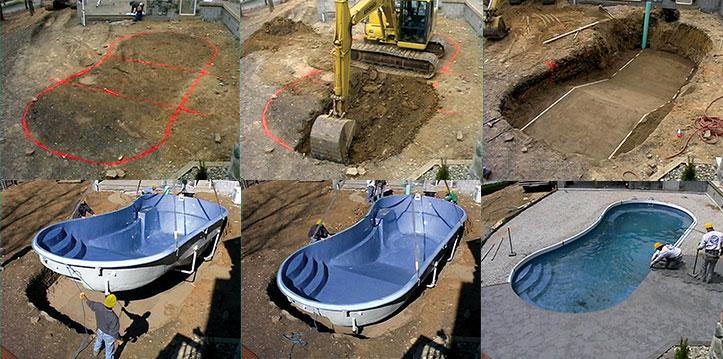
For fiberglass pools, the inspection process is generally more streamlined than for concrete pools because the shell arrives manufactured and engineered. Inspectors can review factory specs rather than evaluating on-site structural pours.
Florida Pool Contractor Licensing Requirements
Florida has one of the most structured pool contractor licensing systems in the country, administered by the Construction Industry Licensing Board (CILB) under the Florida Department of Business and Professional Regulation (DBPR).
There are four primary license types for pool and spa contractors in Florida:
- Certified Commercial Pool Contractor: Covers new construction, repair, or remodeling of any public, commercial, or residential pool.
- Certified Residential Pool Contractor: Covers construction, repair, and servicing of residential pools and spas. This is the license most relevant to homeowners building a backyard pool.
- Certified Pool/Spa Servicing Contractor: Covers installation and replacement of pool equipment, interior finishes, piping, and equipment housing — but not new pool construction.
- Pool/Spa Service (Repair and Remodel/Resurfacing): A more limited scope covering repairs and resurfacing of residential pools only.
To obtain a Certified Residential Pool Contractor license in Florida, an applicant must have a minimum of four years of verified experience in the applicable scope of work (at least one year as a supervisor or foreman), pass both a trade knowledge exam and a business and finance exam through the DBPR, and demonstrate financial stability through a personal credit review.
Before hiring any contractor for your Florida pool project, you can verify their license status through the DBPR’s online licensing portal, linked above. Working with an unlicensed contractor puts your project at risk: permits may be denied, inspections may not be approved, and you could face significant liability if something goes wrong.
For more inform on the Pool Brokers USA Swimming Pool Installation Process, click here. We are happy to consult, install, and answer any questions you may have about fiberglass pool installation in The Sunshine State.
Florida’s Unique Climate Considerations for Pool Installation
Florida’s year-round warmth is one of the biggest draws for pool ownership, but the state’s climate also introduces some considerations that homeowners in other parts of the country don’t face.
The Rainy Season: May – October
Florida’s rainy season runs from roughly May through October, with afternoon thunderstorms, tropical systems, and heavy rainfall common across the state during this period. Rain doesn’t make pool installation impossible, but it can:
- Delay excavation if the ground becomes saturated or unstable
- Pause concrete and deck pours, since wet conditions affect curing
- Slow permitting timelines if inspections need to be rescheduled
- Create backfill complications when soil stays wet too long after shell placement
For Florida homeowners, the window from November through April generally offers more predictable installation conditions. The drier months allow for smoother excavation, faster curing of concrete and deck work, and fewer inspection delays due to weather.
Hurricane Preparedness
If your property is in South Florida or a coastal area, local building codes may include hurricane-resistance requirements for pool enclosures and safety barriers — particularly in Miami-Dade County, which has some of the strictest standards in the state. Make sure your contractor is familiar with any enhanced requirements in your county before finalizing the design.
Fiberglass pools have a distinct structural advantage in Florida’s storm-prone environment. Unlike concrete pools, a fiberglass shell can flex slightly under ground movement without cracking, and a properly anchored fiberglass shell is engineered to resist floating during high-water table conditions, a real advantage in low-lying Florida properties.
High Water Tables
Many Florida properties, particularly in Central and South Florida, sit on high water tables. During excavation and backfill, contractors must manage groundwater carefully to prevent the pool shell from shifting before it’s properly secured. This is a known site challenge in Florida and something your contractor and engineer should assess during the planning phase.
Year-Round Pool Use
On the positive side, Florida homeowners genuinely use their pools year-round, not just for a few summer months. This makes the economics of pool ownership especially compelling here, and it also means that getting a pool heater is less about extending a short season and more about maximizing comfort on cooler winter evenings when water temperatures drop in North Florida.
When Is the Best Time to Start Your Florida Pool Project?
If you’re targeting a pool that’s ready to use by early summer, the math on timing matters. Here’s a realistic timeline:
- Planning and contractor coordination: 2–4 weeks
- Permit application and plan review: 2–8 weeks (varies significantly by county and season)
- Construction (fiberglass): 2–4 weeks once excavation begins
- Final inspections and fill: 1–2 weeks
Working backward from a May or June target date, many Florida homeowners find that starting the planning process in October or November gives the best chance of swimming by early summer, while also allowing construction to take place during the drier and lower-demand months.
Starting in late spring with a goal of swimming “this summer” is possible, but it’s a tight window that depends heavily on permit processing speed at your local building department.
One benefit of installing during the fall or winter: off-peak demand often means greater contractor availability and, in some cases, more competitive pricing.
Learn more about the pool ordering process with Pool Brokers USA
County-Level Variation: Why You Can’t Just Go by State Rules
Florida has 67 counties – and while the Florida Building Code establishes statewide minimums, local building departments can and do add their own requirements on top of those. A few examples:
- Miami-Dade County: Has additional hurricane-resistance standards for pool enclosures and safety barriers beyond what state code requires.
- Broward County: Pool construction plans must account for water drainage systems; some cities within Broward (such as Fort Lauderdale) require a fence affidavit separately from the standard pool permit.
- Orange County: Has specific electrical grounding requirements and an online permitting portal (Fast Track) through which all residential pool permit applications must be submitted.
- Hillsborough County: Requires construction plans to include a statement from the engineer certifying that the pool design accounts for flood-related loads.
- South Florida counties generally: Properties near water, in flood zones, or with septic systems frequently require additional documentation — elevation certificates, soil reports, or dewatering affidavits — that inland properties may not need.
The best first step before submitting any permit application is to contact your local building department directly. Many counties provide a “pool permit packet” online that lists every required document for your specific jurisdiction.
Florida County and City Pool Permit Resources
Every county and city in Florida has the potential to operate differently. Contact your local building department for all the details on what you’ll need to permit and install your pool. Use our list directly below for quick access to resources from every county in Florida.
- Alachua County, Florida – Building Permit Information
- Hendry County, Florida – Building & Licensing Department
- Orange County, Florida – Permits and Licenses One-Stop
- Walton County, Florida – Swimming Pool Permit Checklist and Residential Checklist
- City of Palm Coast, Florida – Building Services Permitting
- Baker County, Florida – Community Development Department Site
- Osceola County, Florida – Permit Applications, Permit Information, Applying for a Building Permit Information
- Union County, Florida – Swimming Pool Permit Application
- Manatee County, Florida – Building Permits Resources
- Jacksonville County, Florida – Residential Permits Information, Private Swimming Pool Safety Affirmation, Swimming Pool/Spa Checklist
- Sumter County, Florida – Application Submission Requirements and Forms
- Levy County, Florida – Building Permits and Building Permit Procedures Information
- Jefferson County, Florida – Building Department
- Escambia County – Permitting Information
- Marion County, Florida – In-Ground Swimming Pool Checklist
- Sarasota County, Florida – Online Permitting
- Nassau County, Florida – Swimming Pool Checklist
- Glades County, Florida – Building Permit Applications
- Hamilton County, Florida – Swimming Pool Permit Application
- Monroe County, Florida – Building and Code Compliance Department
- City of Bunnell – Swimming Pool Permit Checklist and Application
- Liberty County, Florida – Building Department
- Martin County, Florida – Swimming Pool Barrier Requirements, Pool Enclosure Checklist, Pool Enclosure Requirements
- Miami-Dade County, Florida – Swimming Pool Permits and Swimming Pool Barriers Information
- Gadsden County, Florida – Swimming Pool/Spa Permit Application
- Town of Lady Lake, Florida – Pool and Hot Tub Permit Requirements
- Gulf County, Florida – Building Department
- Polk County, Florida – Building Information
- Volusia County, Florida – Permit Center, Residential In-Ground Swimming Pool Submittal Checklist, Applications and Forms, and Residential Permit Information
- Gilchrist County, Florida – Pool and Spa Permit Application
- Wakulla County, Florida – Swimming Pool Owners Application
- Washington County, Florida – Building Department Inquiries
- Okaloosa County, Florida – Permit Guide for Residential Swimming Pool
- Taylor County, Florida – Building/Planning Resources
- Suwanee County, Florida – Building Department (Licenses and Application)
- Clay County, Florida – Building Department
- Indian River County, Florida – Building Division
- Pinellas County, Florida – Permitting Guide
- Franklin County, Florida – Apply for Permits and Licenses
- Lafayette County, Florida – Building Department Services
- Santa Rosa County, Florida – Development Services Pool Permit Application Checklist
- Holmes County, Florida – Building Planning and Zoning Department
- Madison County, Florida – Building Department Services and Permit Applications
- Palm Beach County, Florida – Pool Permit Affidavit of Understanding, Pool Barrier Agreement, Process Document
- Flagler County, Florida – Swimming Pool Permit Requirements and Requirements for Contractors
- Dixie County, Florida – Building Development Services
- Collier County, Florida – Pool Application Requirements
- Lake County, Florida – Residential Pool Permit Checklist, Building Permit Application
- Columbia County, Florida – Building Department Resources
- Seminole County, Florida – Online Building Permits Portal and Pool Safety Affirmation Document
- Lee County, Florida – Pool Application and Permitting Guide
- Desoto County, Florida – Swimming Pool Permit Application Checklist and Permit Application Forms
- City of St. Port Lucie, Florida – Building Permits, Applications, Fees, and Checklists
- St. Lucie County, Florida – Permitting Department and Permit Checklists
- City of Fort Piece, Florida – Online Permitting
- Leon County, Florida – Permit Forms and Documents
- City of Tallahassee – Permit Portal
- St. Johns County, Florida – Building Department Portal
- Calhoun County, Florida – Building Department
- Broward County, Florida – Building Code Division Permit Process
- Charlotte County, Florida – Building Construction Services
- Jackson County, Florida – Building Permit Portal
- Citrus County, Florida – Building Division Information
- Bay County, Florida – Planning and Zoning, Forms and Impacts Fees
- Highlands County, Florida – Building Services
- City of Okeechobee, Florida – Pool Permit Information
- Bradford County, Florida – Building and Zoning Department
- Putnam County, Florida – Permitting Online Portal
- Hernando County, Florida – Building Division and Pool Spa Hot Tub Safety Barrier Affidavit
- Okeechobee County, Florida – Building Department
Please Note: This information is provided for general reference only and does not constitute official guidance. For the most accurate and up to date information on installing a pool in your locality, please check with your local government or governing authorities.
Frequently Asked Questions: Installing a Fiberglass Pool in Florida
Do I need a licensed contractor to pull a pool permit in Florida?
Yes. Florida law requires that a licensed pool contractor apply for most permits related to pool construction, including plumbing and equipment work. The contractor must hold an active license issued by the Construction Industry Licensing Board (CILB) under the Florida DBPR. You can verify a contractor’s license status at myfloridalicense.com before signing any agreement.
Can a homeowner pull their own pool permit in Florida?
In Florida, homeowners can act as their own general contractor (owner-builder) under certain conditions, but this path requires completing an Owner-Builder Disclosure Statement and accepting personal responsibility for the project’s compliance with building codes. Not all counties treat this equivalently, and some jurisdictions may still require a licensed pool contractor for specific scopes of work. Check with your local building department before assuming owner-builder permitting is available for your project.
How long does it take to get a pool permit approved in Florida?
Plan review for a standard residential pool typically takes one to two weeks, but this varies significantly by county and season. High-volume building departments (such as those in Miami-Dade, Broward, Hillsborough, and Orange County) can take four to eight weeks or longer during the spring and early summer peak. Submitting a complete application with all required documentation (sealed engineering plans, site plan, sub-permit applications, safety affirmation) is the most reliable way to avoid delays from revision requests.
What safety features are required for a residential pool in Florida?
Florida law requires that all residential pools be enclosed by a barrier designed to restrict unsupervised access by young children. Specific requirements for barrier height, gate hardware, and alarm systems are defined in the Florida Building Code and enforced at the local level. Because requirements can vary by jurisdiction, we do not publish specific measurements here. Contact your local building department for the exact specifications that apply to your property.
Why is a fiberglass pool a good choice for Florida specifically?
Fiberglass pools offer several advantages that align well with Florida’s climate and conditions. The non-porous gelcoat surface resists algae growth, which is an active concern in Florida’s warm, humid environment. That means less chemical use and easier maintenance year-round. The one-piece flexible shell handles ground movement better than concrete in areas with active soil or high water tables. And the faster installation timeline (typically two to four weeks from excavation to startup, compared to months for concrete) means less time with an open project in a climate where weather can change quickly.
What is the best time of year to install a pool in Florida?
For most Florida homeowners, the fall and winter months (November through February) offer the most favorable installation conditions. The drier weather reduces excavation complications, concrete deck pours are more predictable, and contractor availability is higher than during peak spring and summer demand. If your goal is to have a pool ready for summer, starting the permitting process in the fall gives you a realistic runway.
Does a pool add value to a home in Florida?
In most Florida markets, a professionally installed pool is viewed as a meaningful property enhancement, especially given the state’s outdoor-focused lifestyle and year-round usability. The impact varies by neighborhood, property type, and price point, but Florida homebuyers generally expect and value backyard amenities. A permitted, code-compliant installation protects that investment; an unpermitted pool can create complications during a future sale.
Ready to Start Planning Your Florida Pool?
Understanding the Florida pool permit process is the first step: and the good news is, it’s manageable once you know what to expect. The process is well-documented, contractor licensing is verifiable, and with the right timing, most Florida homeowners can go from approval to swimming in a matter of weeks.
At Pool Brokers USA, we work with Florida homeowners who want a beautiful fiberglass pool without the inflated cost of a traditional full-service installer. Whether you’re interested in our full installation option or want to coordinate your own project as an owner-builder, we’ll walk you through every step of the process.
Latest Posts
The Fiberglass Pool Installation Process, Step by Step
Budgeting for a Fiberglass Pool: Every Cost Beyond the Shell
Saltwater Pools: Why Fiberglass Handles Salt Better Than Concrete
Delivery Day Checklist: How to Inspect Your Fiberglass Pool Shell
How Much Time Does Pool Maintenance Really Take?
Shipping Container Pools or Fiberglass: Which Is Better?
Fiberglass vs. Natural Swimming Pools: A Practical Cost and Maintenance Comparison
Fiberglass vs. Gunite Pools: How Construction Method Shapes Lifespan and Care
Shell Price vs. Total Project Cost: Reading a Fiberglass Pool Quote
The Fiberglass Pool Buying Guide for First-Time Buyers
Visit Our Blog
Share This Post
(opens in a new tab)
(opens in a new tab)
(opens in a new tab)